


"Made in Canada" and "Product of Canada" are two different claims governed by two different regulatory bodies, and most buyers of branded promotional items do not know the distinction. In this post, we explain what the Competition Bureau requires for non-food products, how the CFIA governs food products, why the two labels carry different thresholds, and which six products in our Canadian-made collection genuinely qualify. We also share what is not on our list and why we will not claim it.
What 'Made in Canada' Actually Means at Ethical Swag
When clients ask us for Made-in-Canada branded promotional items, what they usually mean is: something genuinely Canadian. Not assembled here from parts made abroad. Not designed by a Canadian and manufactured overseas. Actually made in Canada.
That is a fair ask. It is also a surprisingly complicated one.
Canadian origin claims are regulated, and they are regulated differently depending on whether you are talking about food products or non-food products. For non-food items, including most customized promotional items such as chargers, bags, apparel, and speakers, the governing body is the Competition Bureau, an independent federal law enforcement agency. For food products like honey and maple syrup, the Canadian Food Inspection Agency (CFIA) applies its own separate framework.
There is also a distinction most buyers have never had reason to learn: "Made in Canada" and "Product of Canada" are not the same claim. They carry different thresholds and different meanings, and using one when you mean the other is the kind of label error that can mislead buyers and create real compliance exposure for suppliers.
At Ethical Swag, we believe the only label worth putting on a product is one you can defend in plain language. So this post is our attempt to do exactly that: explain what the standards actually require, show you the six Canadian-made products in our current collection that qualify, and be honest about why the rest of our catalog does not make the cut.
'Product of Canada' and 'Made in Canada': Two Labels, Two Different Standards
The Competition Bureau's enforcement guidelines for non-food products draw a clear line between these two claims. Both require that the last substantial transformation of the product occurred in Canada, meaning the final significant manufacturing step that gives the product its essential character must be Canadian. But the content thresholds are very different.
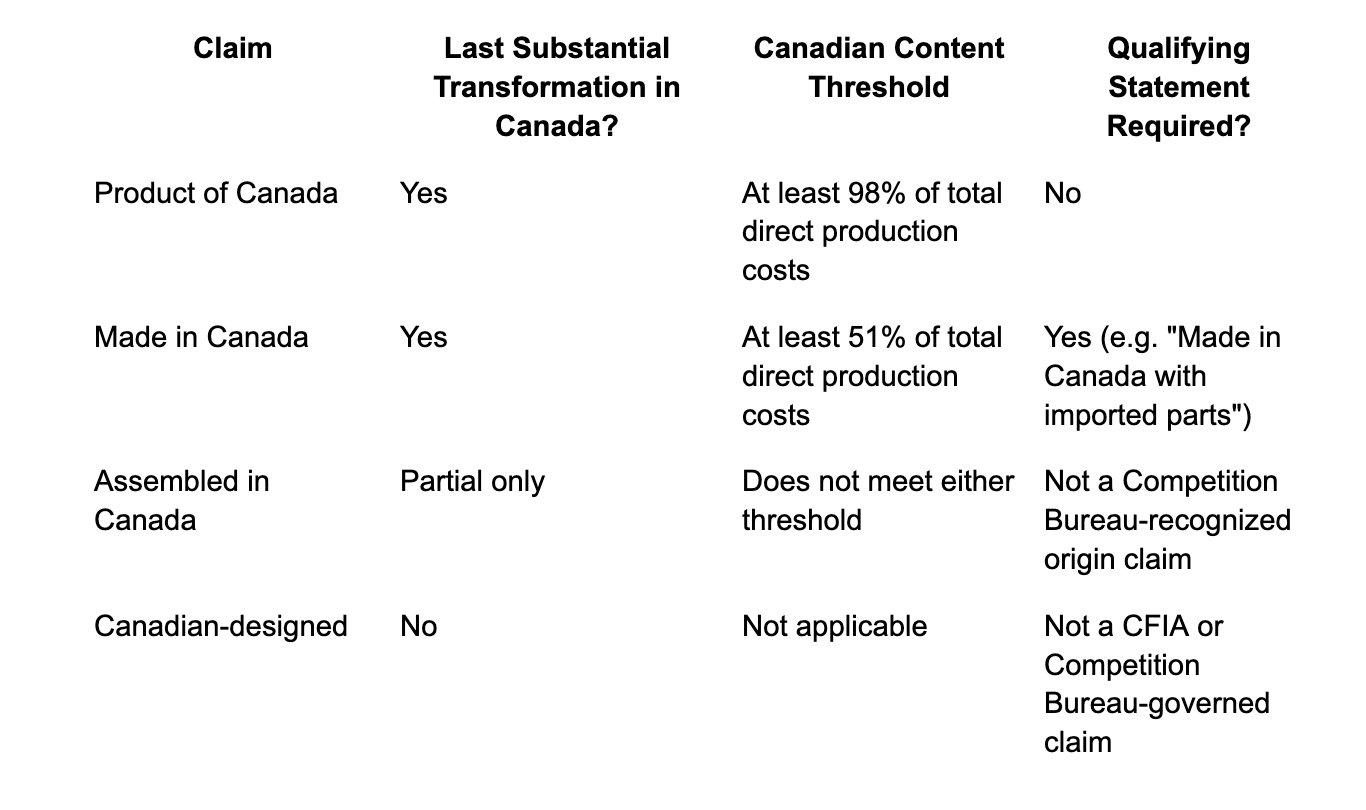
Product of Canada is the higher standard. To use this claim on a non-food product, at least 98% of the total direct costs of producing or manufacturing the good must have been incurred in Canada, and the last substantial transformation must have occurred here. This is an almost entirely domestic product in every meaningful sense.
Made in Canada is the more common claim and applies where at least 51% of the total direct production costs are Canadian and the last substantial transformation happened in Canada. Critically, the Competition Bureau requires that this claim always be accompanied by a qualifying statement, such as "Made in Canada with imported parts" or "Made in Canada with domestic and imported parts." The unqualified "Made in Canada" on its own, without any qualifier, does not meet the Bureau's guidelines when imported content is involved.
The Bureau also notes that general terms like "manufactured in Canada" or "produced in Canada" are interpreted by consumers as synonymous with a Made in Canada claim and should meet the same requirements. Visual representations such as a maple leaf or Canadian flag can also constitute an implicit origin claim subject to the same standards.
Food Products: Where the CFIA Framework Applies
For food products, the regulatory framework shifts. The Competition Bureau's guidelines apply specifically to non-food products. The Canadian Food Inspection Agency (CFIA) administers its own separate guidance for origin claims on food products under the Safe Food for Canadians Act.
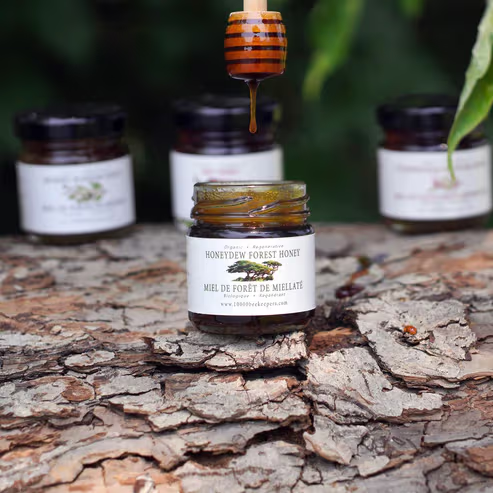
Two of the six Canadian-Made products featured in this blog are food items: our Mini Bee Good Do Good Honey and our Maple Syrup. For these products, CFIA standards apply. The maple syrup is fully Canadian in origin, tapped and bottled in Canada with no imported content. The honey is processed and bottled in Canada by a Canadian company.
This honey travels from African forest canopies to regional hubs for initial grading and cleaning, then ships in ocean containers to Bee Good Do Good’s home base in Ontario. There, the Canadian team handles gravity straining, bottling, and the creation of specialty blends like hot honey, cacao, and cinnamon infusions. The finished product is bottled and blended in Canada. We are featuring it here because of the integrity of the supply chain, the values embedded in the brand, and the story it tells.
The distinction matters when you are assembling a mixed branded gift set. The non-food items in the set are assessed under Competition Bureau guidelines. The food items are assessed under CFIA rules. Both bodies share the foundational requirement of last substantial transformation in Canada, but their content thresholds and labelling requirements differ.
Electronics and the Last Substantial Transformation Standard
One of the more nuanced areas involves electronic products. Electronic components such as battery cells, microchips, and circuit boards are globally sourced commodities. No manufacturer, anywhere in the world, produces every component of a finished electronic product domestically. The Competition Bureau's substantial transformation standard accounts for this reality. What matters is whether the manufacturing process, product engineering, quality testing, and final production occurred in Canada, such that the resulting product is fundamentally different from its imported component parts.
For both the Made in Canada charger and the Maxime Speaker, that transformation happens in Canada. The engineering, assembly, and quality assurance are domestic. The 51% Canadian direct cost threshold is met when battery cells are assessed in the context of the overall production cost structure. These products carry a "Made in Canada with imported parts" claim, which is the correct and fully compliant Competition Bureau formulation.
This is not a loophole. It is precisely how the standard was designed to work for manufactured goods in a global supply chain.
Six Products in Our Canadian-Made Collection That Qualify
Here are six products from our Canadian-made collection, each one meets the applicable regulatory standard, either the Competition Bureau framework for non-food items or the CFIA framework for food products. Here is what is in the collection and what standard each one qualifies under:
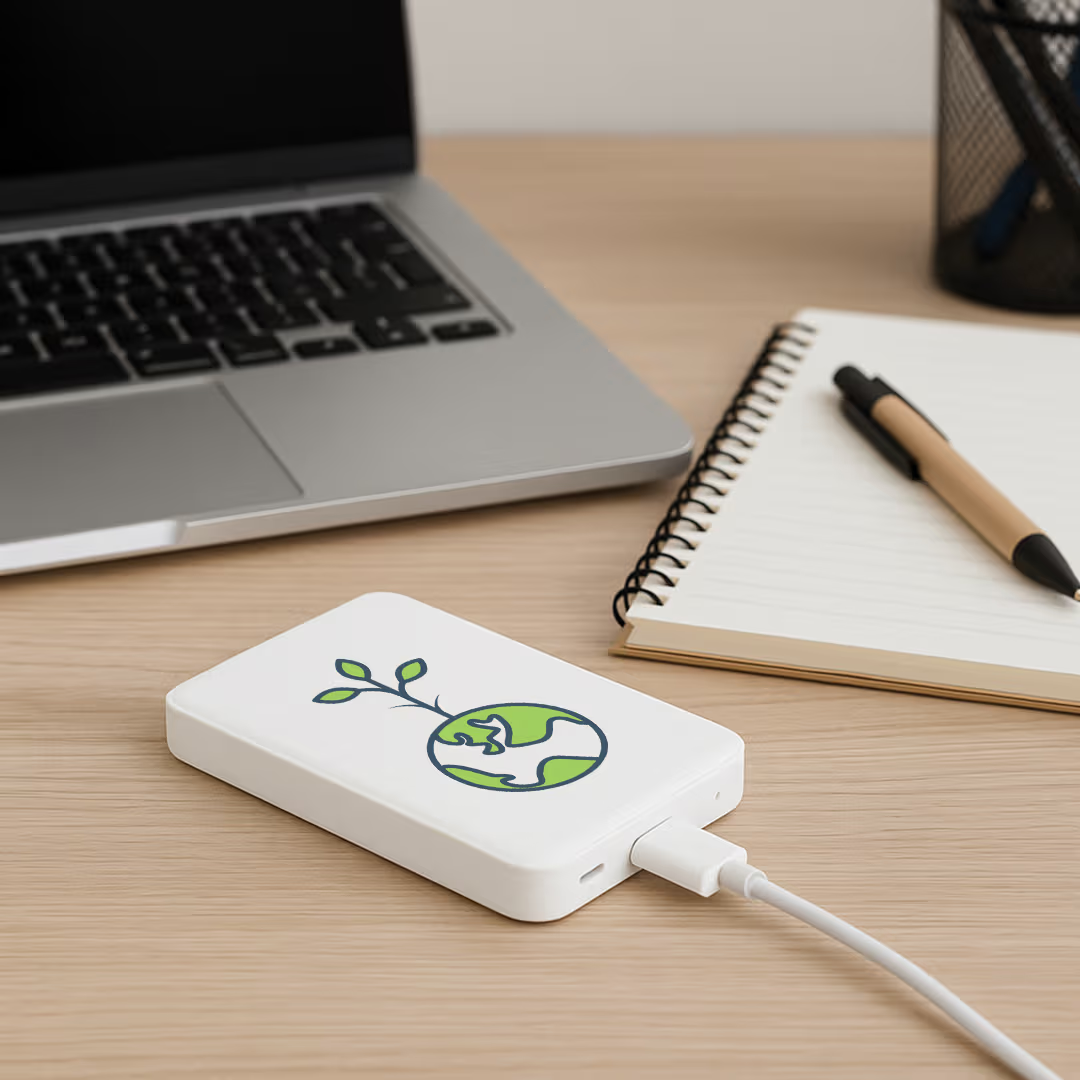
Made in Canada Portable Charger
Manufactured in Canada. Engineering, product development, assembly, and quality assurance are all domestic. Battery cells are sourced internationally, consistent with standard global electronics manufacturing practice. This product qualifies under the Competition Bureau's "Made in Canada with imported parts" standard.
Ottawa Pocket Hoodie Unisex
Cut, sewn, and finished in Canada using domestic labour throughout the manufacturing process. Canadian content costs meet the 51% threshold. This product qualifies under the Competition Bureau's "Made in Canada" standard with an appropriate qualifying statement where imported fabric content is present. It is one of the cleanest domestic apparel claims available in customized promotional items.

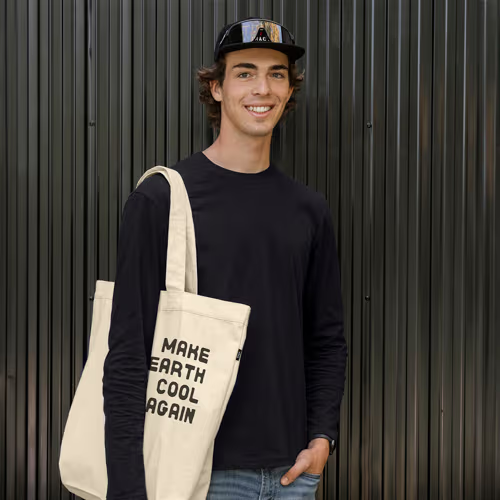
Made in Canada Large Tote Bag
Manufactured in Canada from domestically sourced materials, meeting both the last substantial transformation and 51% content cost requirements. Depending on content composition, this product may qualify for an unqualified "Made in Canada" or "Product of Canada" claim.
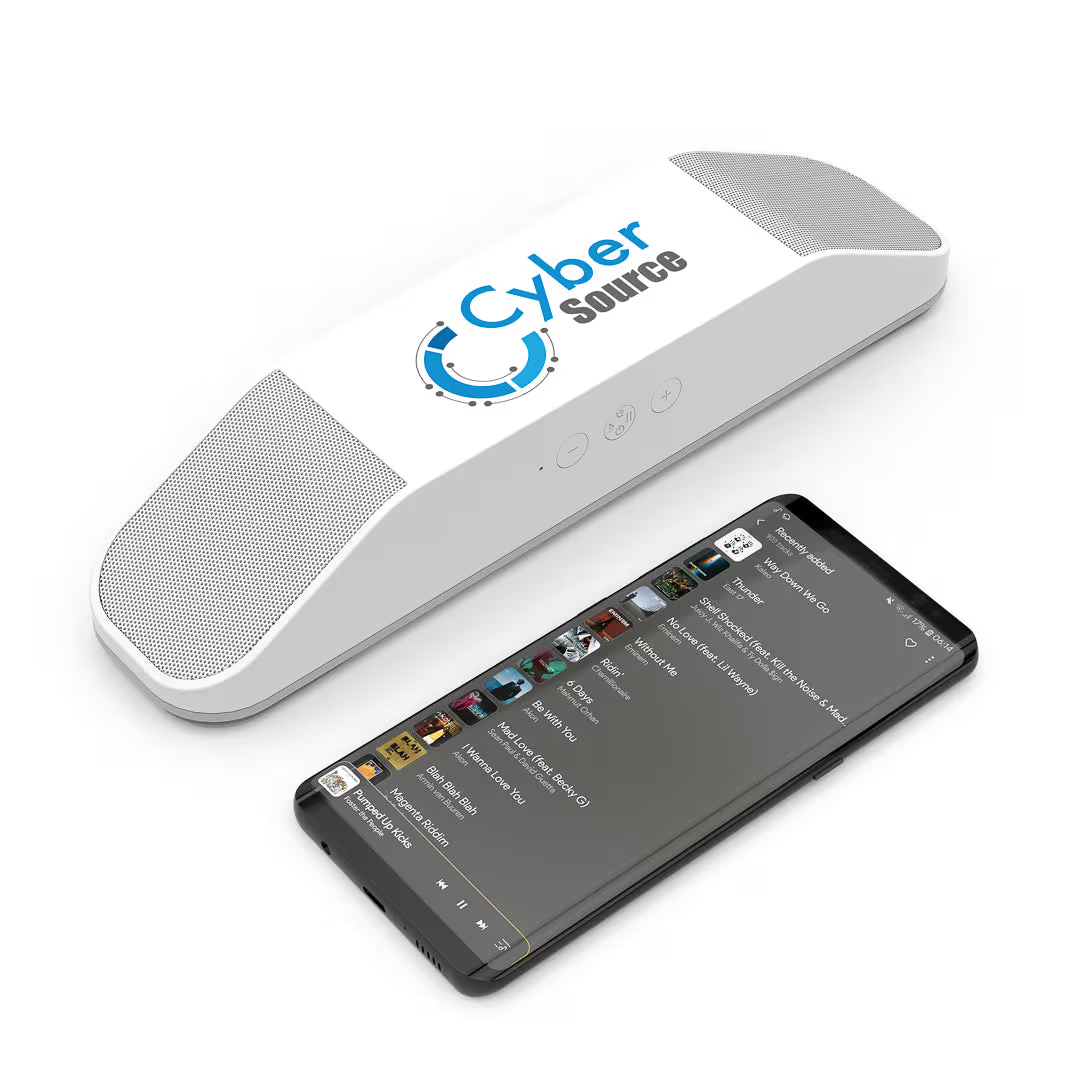
Maxime Speaker and Wireless Charger
Manufactured in Canada with globally sourced electronic components. Engineering, design, assembly, and testing are all domestic. Qualifies under the "Made in Canada with imported parts" standard.
Mini Bee Good Do Good Honey Gift Set
Canadian honey from Canadian bees, processed and packaged in Canada. Fully domestic from source to shelf with no imported content. Qualifies under CFIA food origin standards with a clean, unqualified Canadian origin claim. The Bee Good Do Good brand also carries a values-aligned story that pairs well with purpose-driven gift programs.
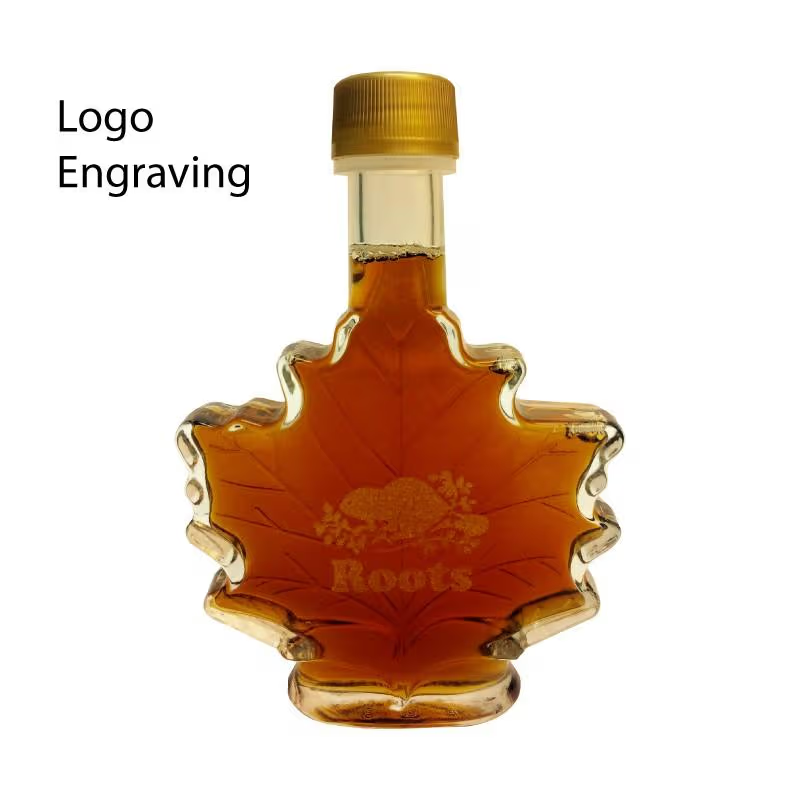
Pure Canadian Maple Syrup in Leaf Glass Bottle 250 mL
Canadian maple sap harvested, processed, and bottled in Canada. Fully domestic with no imported content. Qualifies under CFIA food origin standards. One of the most internationally recognized Canadian products available, making it a strong choice for clients gifting to global audiences.
What Is Not on Our List and Why We Will Not Claim It
The honest version of this post requires acknowledging what is not in the collection, and why.
The majority of customized promotional items available in our catalog, and across the promotional products industry broadly, are manufactured outside Canada. This includes products made in countries with strong labour and environmental standards, items we have vetted through our supplier compliance framework, and products we stand behind for quality and ethical sourcing.
But they are not Made in Canada. And we will not call them that.
The Competition Bureau is clear that terms like "manufactured in Canada" or visual cues like maple leaf imagery carry the same weight as an explicit origin claim. Using them on a product that does not meet the standard is not a technicality. It is a false or misleading representation under the Competition Act, with meaningful compliance exposure.
As a B Corp, our claims are documented and auditable. We report to the UN Sustainable Development Goals. We operate as a zero-carbon business. Applying a Canadian origin label to a product that does not qualify would be inconsistent with that framework, regardless of how broadly the term is used elsewhere in the industry.
If a product is not in this collection, it means we have not been able to confirm it meets the applicable standard. That is not a comment on its quality. It is a commitment to saying what we mean.
How Ethical Swag Supports Organizations That Need Verifiable Sourcing
For procurement teams, sustainability leads, and HR professionals who need to answer sourcing questions with confidence, Ethical Swag offers something most promotional product suppliers cannot: documented transparency on origin claims.
Our women-owned status and our commitment to zero-carbon operations are not marketing positions. They are audited and verified. The same standard applies here. Every product in our Made-in-Canada collection has been reviewed against the Competition Bureau framework for non-food goods or the CFIA framework for food products before being included.
Our Good/Better/Best framework applies here too. A Made-in-Canada branded gift that carries a meaningful values story, like our Bee Good Do Good honey, represents the Best tier: products that do something beyond branding.
If Canadian provenance matters to your organization's brand story, procurement policy, or gift-giving mandate, this collection gives you a documented, defensible place to start.
Frequently Asked Questions
What is the difference between 'Product of Canada' and 'Made in Canada'?
These are two distinct claims under the Competition Bureau's enforcement guidelines for non-food products. "Product of Canada" requires that at least 98% of total direct production costs were incurred in Canada and that the last substantial transformation occurred here. "Made in Canada" requires a lower 51% Canadian content threshold and last substantial transformation in Canada, but must always be accompanied by a qualifying statement such as "Made in Canada with imported parts." The unqualified "Made in Canada" label, without any qualifier, does not meet Competition Bureau guidelines where imported content is involved.
Who governs 'Made in Canada' claims for non-food promotional products?
The Competition Bureau, an independent federal law enforcement agency, governs origin claims for non-food products under the Competition Act, the Consumer Packaging and Labelling Act, and the Textile Labelling Act. The Canadian Food Inspection Agency (CFIA) governs origin claims for food products under a separate framework. Both bodies share the foundational requirement that the last substantial transformation of the product occurred in Canada.
Does a maple leaf logo or Canadian flag on a product count as an origin claim?
Yes, according to the Competition Bureau. Pictorial representations such as a maple leaf, Canadian flag, or other symbols associated with Canadian identity can constitute an implicit origin claim subject to the same standards as an explicit "Made in Canada" statement. If the general impression created by that imagery is that the product was made in Canada, the Competition Bureau will assess it against the Product of Canada or Made in Canada criteria.
Why do electronic products with imported battery cells still qualify for a Made in Canada claim?
The Competition Bureau's substantial transformation standard focuses on where the fundamental change in the product occurred, not on whether every component was sourced domestically. For electronics, battery cells and microchips are globally sourced commodities. When the engineering, manufacturing, assembly, and quality testing of the finished product happen in Canada, and when Canadian direct costs meet the 51% threshold, the product qualifies for a "Made in Canada with imported parts" claim. This is how the standard was designed to work for manufactured goods in a global supply chain.
Are all Ethical Swag products Made in Canada?
No, and we want to be clear about that. Our Canadian-made collection currently includes six products. The rest of our catalog sources from international manufacturers, many of whom meet strong labour and environmental standards. We will not apply Canadian origin language, including implicit claims like maple leaf imagery, to any product that does not meet the applicable Competition Bureau or CFIA standard.
Can I build a full Canadian-made branded program from this collection?
Our Canadian-made collection currently offers six products ranging from $25 to $105 that can be combined into a curated gift set. If you are building a larger program and Canadian provenance is a core requirement, we recommend booking a call with our team. We can help you design a solution that meets your sourcing criteria, budget, and timeline.
Ready to Build a Genuinely Canadian-Made Branded Program?
If your organization needs customized promotional items with a verifiable Canadian provenance, our team can help you put together a program that holds up to scrutiny.
We can walk you through the full Canadian-made collection, help you pair Made-in-Canada products with our broader Good/Better/Best catalog, and design a gift or event strategy that aligns with your budget, timeline, and values.
Book a call with the Ethical Swag team.
Whether you are sourcing for a team event, a client gifting campaign, or an HR onboarding program, we will make sure you can answer the question "Where was this made?" with complete confidence.