


Not all sustainability claims are created equal. In the promotional products industry, terms like 'eco-friendly' and 'natural' appear on thousands of items without any third-party verification behind them. This post breaks down how to read a sustainability claim with confidence: which certifications carry real weight, what to look for at the brand level versus the product level, three questions to ask any supplier before you buy, and a real example of how Ethical Swag vets a new product before it enters the catalog. Whether you are sourcing customized promotional items for a conference, a corporate program, or a seasonal gifting initiative, this guide gives you the tools to cut through the noise and choose products that actually align with your values.
You are reviewing branded promotional items for your next company event or employee welcome kit. The supplier website is full of reassuring language: 'eco-friendly tote,' 'sustainable water bottle,' 'made with natural materials.' It sounds right. It feels aligned with your company values. But what does any of it actually mean?
In most cases, very little. These are marketing descriptors, not verified standards. If your organization is working toward ESG commitments, B Corp certification, or a public sustainability pledge, the difference between a claim and a certification matters more than you might think.
This post is a plain-language guide to decoding sustainability claims on promotional products. No jargon, no guilt, just the tools you need to make confident, informed sourcing decisions.
"Eco-Friendly" Is Not a Certification. Here Is What to Look for Instead.
Walk through any major promotional products marketplace and you will see "eco-friendly" applied to hundreds of items: pens made with wheat straw, bags labeled as recycled, notebooks described as sustainable. The term is everywhere, and on its own, it does not tell you very much.
There is no governing body that defines what "eco-friendly" requires. There is no audit. There is no threshold a product must meet before a supplier can apply the label. A pen with two percent post-consumer plastic qualifies by the same logic as a product made entirely from certified organic materials. The word describes intent, not proof.
This is not a criticism unique to any one supplier. "Eco-friendly" is a broadly used descriptor across the promotional products industry, including in product listings throughout our own catalog. The issue is not the word itself but what buyers do with it. If "eco-friendly" is the only sustainability signal on a product, it is worth asking what is actually behind it.
What holds up to scrutiny is certification. A product carrying a GOTS certification has been verified against a global standard for organic textiles. An FSC label means the paper or wood content was sourced from responsibly managed forests. A GRS verification confirms recycled content claims have been independently audited. OEKO-TEX tests for harmful substances. Fair Trade and SA8000 address labor conditions at the production level.
When we describe a product's sustainability credentials, we lead with what is verifiable: third-party certifications, material standards, and documented supply chain practices. That is the standard we apply to ourselves, and it is the standard we encourage our clients to apply when evaluating any supplier.
Why this matters for your organization:
If your sustainability reporting references specific product sourcing, procurement decisions need to be traceable. A product labeled 'eco-friendly' with no certification behind it cannot support a Global Reporting Initiative (GRI) disclosure, a Scope 3 emissions estimate, or a supplier diversity claim. Certified products can.
The Four Certifications That Mean the Most for Promotional Products
Sustainability certifications span dozens of industries and standards. For the promotional products category specifically, four stand out as the most relevant, most rigorous, and most likely to appear on products your organization would actually want to source.
1. GOTS: Global Organic Textile Standard
GOTS is the benchmark for organic textiles. To carry a GOTS certification, a product must use a minimum of 70 percent certified organic fibers, and every stage of processing from fiber to finished product must meet strict environmental and social criteria. This includes limits on chemical inputs, wastewater treatment requirements, and labor standards at each facility in the supply chain.
For promotional products, GOTS is most relevant to apparel, tote bags, and any textile item. A GOTS label is not something a supplier can self-apply. It requires third-party inspection and certification of the entire supply chain.
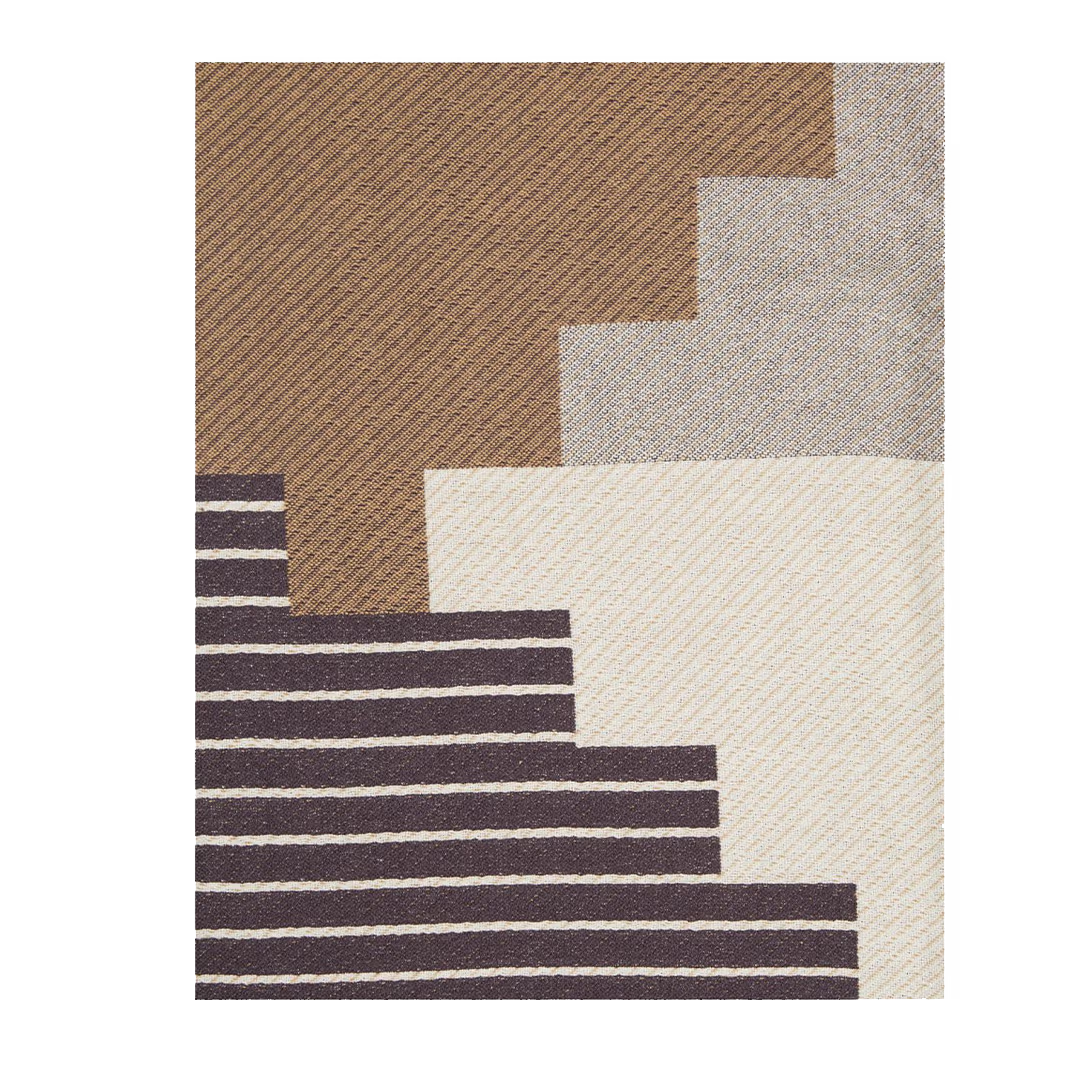
Tentree® Organic Cotton Modernist Woven Blanket
2. GRS: Global Recycled Standard
GRS verifies that recycled content claims are accurate. A product claiming to contain recycled PET, recycled cotton, or any other recycled material can only carry the GRS label if that claim has been independently verified through a chain-of-custody audit.
This matters because recycled content claims are among the most commonly misused in promotional products. GRS closes that gap by requiring documentation at each stage of production, from the facility collecting the post-consumer or post-industrial material through to the finished item.
Clair Recycled PET Bamboo Lid Water Bottle 22 oz

3. OEKO-TEX Standard 100
OEKO-TEX Standard 100 tests textile products for harmful substances. A certified product has been tested against a list of over 100 restricted substances including pesticide residues, heavy metals, formaldehyde, and certain dyes. Every component of the finished product must pass, including threads, buttons, and zippers.
While OEKO-TEX does not certify the entire production process the way GOTS does, it provides strong assurance that the product itself is safe for end users. For organizations distributing branded gifts to employees or event attendees, this is meaningful peace of mind.

4. Fair Trade Certified
Fair Trade certification focuses on the human side of the supply chain. It requires verified labor standards, safe working conditions, fair wages, and community investment practices at production facilities. For promotional products, Fair Trade is most commonly associated with cotton apparel, bags, and food items like coffee or chocolate used in gift kits.
Organizations with social equity commitments, supplier diversity programs, or ESG reporting aligned with SDG 8 (Decent Work and Economic Growth) will find Fair Trade certification particularly relevant when choosing customized promotional items.
Mini Bee Good Do Good Gift Set

A note on FSC certification:
For paper-based products, notebooks, packaging, and wood items, the Forest Stewardship Council (FSC) certification is the standard to look for. FSC ensures that paper and wood products come from responsibly managed forests. If your promotional program includes any printed materials, journals, or packaging, FSC is the certification that matters.
Certified Maple Wood Bluetooth Mini Speaker

What We Look for at the Brand Level Versus the Product Level
One of the most useful distinctions to understand when evaluating a supplier is the difference between brand-level and product-level credentials. These are not the same thing, and confusing them is a common source of greenwashing.
Brand-Level Credentials
Brand-level credentials speak to how the company itself operates. These include:
B Corp certification, which requires a company to meet rigorous standards across governance, workers, community, and environment
Women-owned, BIPOC-owned, or other supplier diversity certifications
ISO 14001 environmental management certification
Membership in recognized industry sustainability frameworks or coalitions
Public carbon commitments, third-party audited emissions reporting, or zero-carbon operations
Alpine Henley Long Sleeve Button-Placket Shirt-Men's

Brand-level credentials tell you something about the values and accountability structure of the organization you are doing business with. They do not tell you whether any specific product meets a sustainability standard.
Product-Level Credentials
Product-level credentials speak to how a specific item was made, what it contains, and who produced it. These include the certifications described above: GOTS, GRS, OEKO-TEX, Fair Trade, FSC, and others like SA8000 for social accountability.
A supplier can be a certified B Corp and still sell products with no third-party product certifications. Conversely, a supplier might carry GOTS-certified apparel without having any meaningful brand-level sustainability commitments. Neither scenario is inherently wrong, but both matter when you are trying to make a sourcing decision that holds up to scrutiny.
At Ethical Swag, we hold credentials at both levels. As a certified B Corp and women-owned business with zero-carbon operations and UN SDG reporting, our brand practices reflect the same values we apply to product sourcing. When we carry a certified product, we disclose the specific certification and what it covers. When a product does not carry a formal certification but meets other sourcing criteria, we say that clearly too.
Thule Legacy Notus 15 Inch Laptop Backpack 20L

Three Questions to Ask Any Swag Supplier Before You Buy
You do not need to be a sustainability expert to make better sourcing decisions. You just need to ask the right questions and know what a credible answer looks like.
1. Can you show me the certification documentation for this product?
A supplier with legitimate certifications should be able to point you to the certificate, the certifying body, and the scope of what is covered. 'We source sustainably' or 'our factory is audited' are not the same as a verifiable third-party certification. Ask for the actual documentation.
If a supplier cannot produce documentation, that does not necessarily mean the product is problematic. It does mean you should treat any sustainability claim as unverified and factor that into your decision.
2. What is the chain of custody for this product's key materials?
Chain of custody refers to the trail of documentation that tracks a material from its origin through each stage of processing to the finished product. For a recycled polyester bag to carry a GRS certification, the chain of custody must be documented at every stage. Ask your supplier to explain where the materials come from and how that is verified.
A supplier who can answer this question with specifics, naming the factory, the raw material source, and the certifying body, is a supplier who has done the work. A supplier who responds with generalities about 'ethical sourcing' without specifics has not.
3. What happens to this product at end of life?
Sustainability does not end at production. A product made from certified organic cotton but destined for the landfill after one use is still generating waste. Ask your supplier whether the product is designed for durability, compostability, or recyclability, and whether those claims are backed by any standard.
This is also a useful question for filtering out products that are technically certified but practically low-quality. A well-made item that lasts years generates less environmental impact than an inexpensive item with a green label that falls apart in a season.
One Real Example: How Ethical Swag Vets a New Product
We want to make this concrete, so here is a walkthrough of how we evaluate a new product before it enters our catalog. For this example, we will use an organic cotton tote bag, one of the most popular categories in sustainable promotional products and also one of the most frequently misrepresented.
Step 1: Material Claim Verification
The first thing we look at is the material claim. A supplier says the bag is made from organic cotton. We ask: certified by whom? We request the GOTS certificate number, then verify it independently through the GOTS public database at global-standard.org. The certificate must be current, must cover the specific factory producing the bag, and must cover the product category (in this case, made-up textile goods).
If the certificate checks out, we note the certification scope and the certification body. If the certificate has lapsed or the factory is not listed, the product does not move forward regardless of how the supplier describes it.
Step 2: Factory and Labor Standards Review
We review the production facility against our supplier compliance standards. We look for SA8000 certification or equivalent audit documentation covering wages, working hours, health and safety, and prohibition of child and forced labor. For factories in high-risk sourcing regions, we apply additional scrutiny and may request more recent audit documentation.
We also look at whether the supplier has signed on to any industry accountability frameworks and whether they have a disclosed grievance mechanism for workers.
Step 3: Product Quality and Longevity Assessment
We evaluate the product itself. For a tote bag, we look at the weight of the fabric (a common indicator of durability), the construction of the handles, the stitching at stress points, and the quality of any printing or embroidery. A bag that fails after ten uses undermines the sustainability case for the material it is made from.
We also confirm that the product meets our own standards for customization quality, because a promotional product that does not represent your brand well is not serving its purpose regardless of its certifications.
Step 4: Classification in Our Good/Better/Best Framework
Once a product passes the above review, we place it within our Good/Better/Best product framework. This helps clients understand where a product sits on the sustainability spectrum relative to other options in the same category:
Good = cost competitive, comparable to other products on the market but sourced from suppliers who have passed 3rd party audits on social compliance and environmental impact.
Better = always cost competitive and have some sustainable features (recycled content, material made from rapidly renewed resources, biodegradable, etc.)
Best = sourced as closely as possible to North American made, preferred use of sustainable material, third party accreditation, and/or supplier is Cert B Corp and/or supplier has significant audited giving projects, etc. Product quality is very high AND it is still cost competitive.
This framework is not a pass/fail system. It is a tool for informed decision-making. A client with a specific budget may choose a Good-tier product with clear eyes about what that means. A client preparing a sustainability report may prioritize Best-tier products in specific categories. Both are valid decisions, and both are better than choosing based on unverified marketing language.
Want to learn more about our Good/Better/Best system? Click here to access our Emoji Rating Guide.
How Ethical Swag Supports Values-Aligned Procurement
Ethical Swag is a Certified B Corp and women-owned promotional products distributor with zero-carbon operations. We report against the United Nations Sustainable Development Goals and apply the same accountability standards to our suppliers that we hold ourselves to.
Our product catalog is built on verified sourcing criteria, not marketing language. When a product in our catalog carries a certification, we document it. When it does not, we say so. And when you work with our team, you get access to a supplier who can answer the three questions above with specifics, not generalities.
We work with procurement teams, sustainability managers, HR leaders, and event marketers across North America to source customized promotional items, branded gifts, and event giveaways that reflect their organizational values and hold up to scrutiny in a sustainability report or board presentation.
Frequently Asked Questions
How do I know if a corporate gift is actually sustainable?
Look for third-party certifications rather than marketing language. Certifications like GOTS, GRS, OEKO-TEX, Fair Trade, and FSC are verified by independent bodies and require specific criteria to be met. Terms like 'eco-friendly,' 'natural,' or 'green' have no standardized definition and cannot be independently verified. Ask any supplier for the actual certification documentation, including the certificate number and the certifying body, and verify it directly through the certifying organization's public database.
What sustainability certifications matter most for promotional products?
The certifications with the most relevance to the promotional products category are GOTS (for organic textiles), GRS (for recycled content claims), OEKO-TEX Standard 100 (for product safety in textiles), Fair Trade (for labor and community standards), and FSC (for paper, wood, and packaging). The most important certification for any given product depends on the material and category. A certified B Corp supplier adds an additional layer of accountability at the brand level, but does not replace product-level certifications.
What is the difference between a brand-level certification and a product-level certification?
Brand-level certifications, like B Corp, speak to how the company itself operates: its governance, labor practices, environmental management, and community impact. Product-level certifications, like GOTS or GRS, speak to how a specific item was made and what it contains. Both are valuable and serve different purposes. When evaluating a supplier, look for both: a supplier with strong brand-level credentials and verified product-level certifications is the most accountable option.
Can I request certification documentation before placing an order?
Yes, and you should. Any credible supplier should be able to provide current, verifiable certification documentation for any product they are representing as certified. If a supplier cannot produce documentation or deflects the question, treat the sustainability claim as unverified. At Ethical Swag, providing certification documentation is a standard part of our client process.
Does a more expensive certified product always mean better sustainability outcomes?
Not necessarily. Price is one factor among several. A higher-priced certified product is not automatically more sustainable than a moderately priced one with equivalent certification coverage. The most useful question is whether the product has verifiable certifications appropriate to its category, whether it is made to a quality standard that supports longevity, and whether it meets your organization's specific values criteria. Our Good/Better/Best framework is designed to help clients navigate this comparison with clarity.
What is greenwashing and how does it affect promotional product sourcing?
Greenwashing refers to the practice of making misleading or unverifiable environmental claims about a product or company. In promotional products, greenwashing most commonly takes the form of unqualified terms like 'eco-friendly,' 'sustainable,' or 'recycled' applied to products with no third-party verification. For organizations with genuine sustainability commitments, sourcing based on greenwashed claims creates reputational and reporting risk. The best protection is a documented commitment to verified certifications and a supplier relationship built on transparency.
How long does it take to receive certified promotional products from Ethical Swag?
Standard orders are fulfilled within 15 business days from the date the order is paid, covering both production and delivery. For time-sensitive needs, our Swift Swag rush service delivers in 10 business days from the paid order date. Both timelines apply to orders shipped within our standard service areas across Canada and the United States.
Ready to Source Promotional Products You Can Stand Behind?
Book a free call with the Ethical Swag team. We will walk you through product options that align with your values, your budget, and your reporting requirements, with certification documentation to back it up.